
H2 for e‑SAF: H2’s first clean lead market
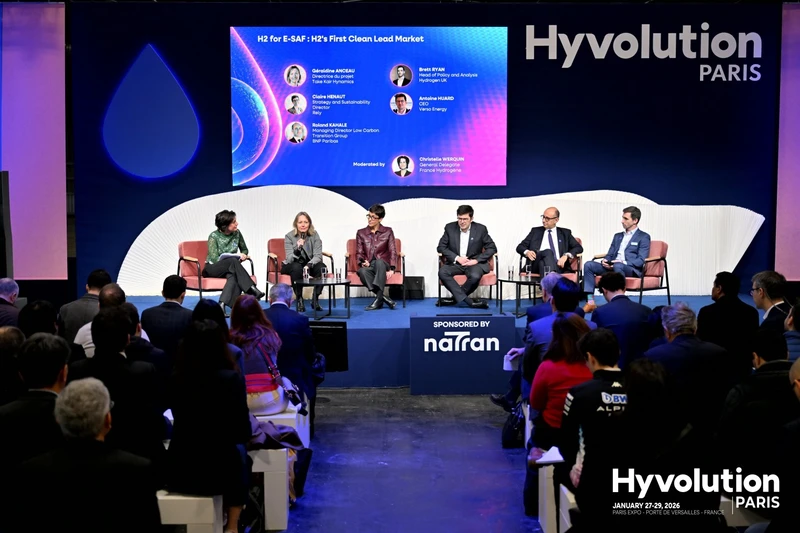
Below is the full summary of the roundtable “H2 for e‑SAF: H2’s first clean lead market”, presented at Hyvolution Paris 2026.
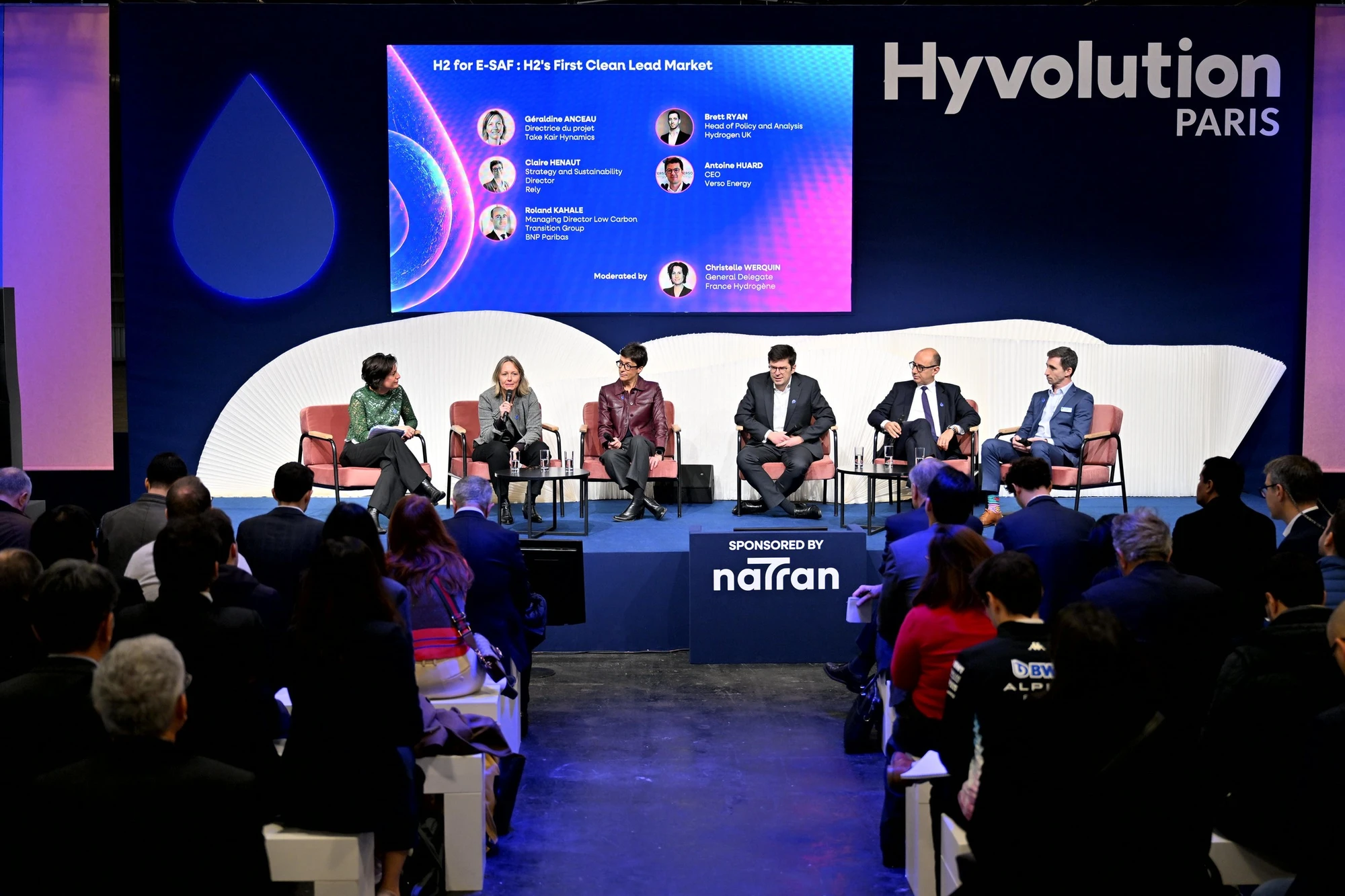
January 28th, 2026 – Hyvolution Paris
Below is the full summary of the roundtable “H2 for e‑SAF: H2’s first clean lead market”, presented at Hyvolution Paris 2026.
Context and challenges
- Since January 2025, ReFuelEU Aviation has fully come into force and e‑SAF has moved from being an ambition to becoming a legally enforced market, with applied penalties which create immediate demand.
- Aviation now faces a synchronisation challenge: scaling low‑carbon hydrogen and biogenic CO₂ supply fast enough to meet requirements, while projects still struggle to reach economic viability and FID.
Perspective
E‑SAF is positioned as a first hydrogen lead market: mandates exist and volumes are known, but delivery now depends on aligning industrial execution, offtake commitments, and financing mechanisms fast enough to meet demanded volumes.
Main messages
1. E‑SAF projects are technically feasible, but their success depends on industrial coordination and execution at scale
Géraldine Anceau shows that e‑SAF projects rely on the simultaneous production of electricity, hydrogen, biogenic CO₂, water, permitting and local stakeholders. These long development cycles push FIDs toward 2030. Claire Henaut stresses that the main challenge is no longer individual technologies, but the integration of multiple technologies into a single, reliable industrial system, where execution risk and CAPEX concentration are decisive.
2. Competitiveness will be driven by scale, replication and standardisation
Antoine Huard explains that large‑scale, replicable project portfolios are essential to reach critical size, reduce costs and reassure off takers through portfolio effects and operational flexibility. Claire Henaut reinforces that moving away from bespoke engineering toward standardised, modular designs is key to accelerating delivery, reducing CAPEX and making projects bankable.
3. Bankability is the main constraint, making long‑term offtake and revenue certainty mechanisms essential
Roland Kahale highlights that e‑SAF projects are constrained by affordability and revenue predictability rather than feasibility, with lenders requiring robust long‑term offtake agreements to finance CAPEX‑intensive plants. Brett Ryan presents the UK Revenue Certainty Mechanism as a concrete solution to de‑risk first‑of‑a‑kind projects by guaranteeing revenues over 15 years, offering a potential blueprint for Europe.
Key takeaways
- E‑SAF is now a regulated market, not a pilot sector: mandates and penalties create real demand, shifting the focus to execution and investment readiness.
- The race is about bankability and contracting: long‑term offtake and revenue certainty mechanisms are the key triggers for FIDs.
- Timing is critical for 2030 delivery: contracts and de‑risking tools must come early enough to match industrial lead times and avoid a supply gap.
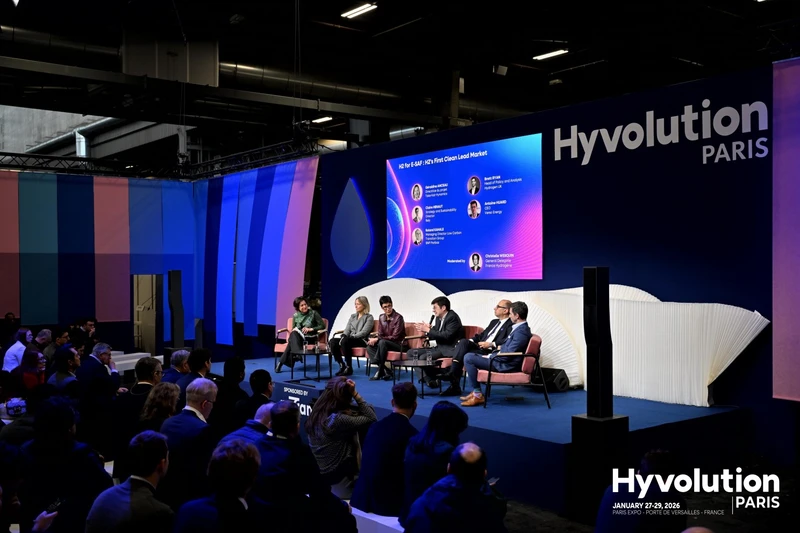
Speakers
🎤 Géraldine Anceau, Project Director of the Take Kair – Hynamics
🎤 Antoine Huard, CEO – VERSO ENERGY
🎤 Claire Henaut, Strategy and Sustainability Director – Rely
🎤 Roland Kahale, Managing Director Low Carbon Transition Group – BNP Paribas
🎤 Brett Ryan, Head of Policy and Analysis – Hydrogen UK
🎤 Christelle Werquin, General Delegate – France Hydrogène
Analytical synthesis courtesy of SIA Partners.