
Heavy-duty trucking: lessons learned, strong perspectives
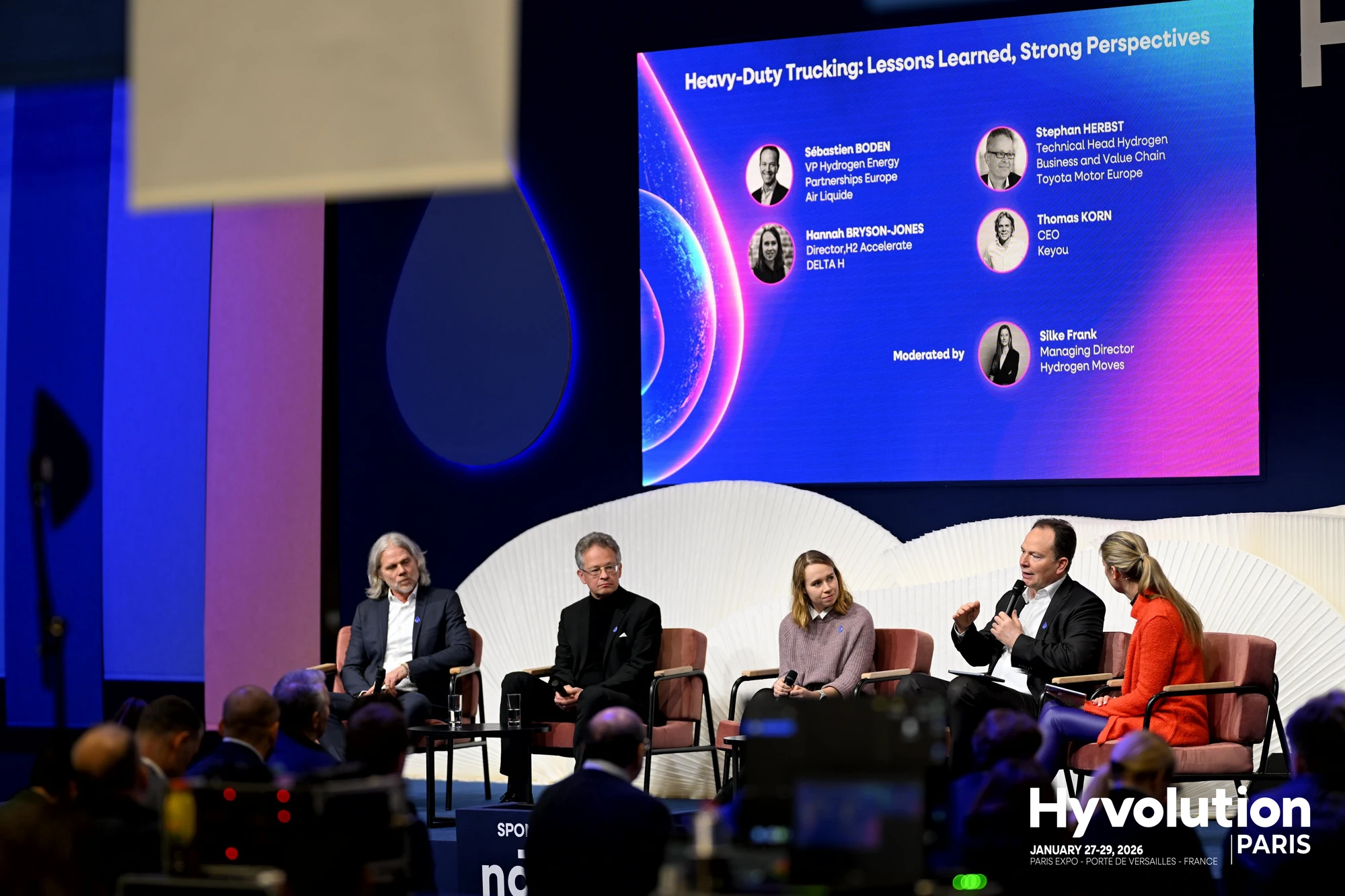
January 28th, 2026 – Hyvolution Paris
Below is the full summary of the roundtable held on January 28th, 2026, at Hyvolution Paris, focusing on hydrogen solutions for heavy‑duty transport.
Context and challenges
- Heavy‑duty transport is at a turning point: hydrogen versus battery‑electric is no longer theoretical, the question is what works at scale.
- The challenge is moving from scattered pilots to robust, repeatable ecosystems with trucks, stations and competitive hydrogen prices aligned.
- Europe must clarify how to scale quickly while other regions, notably Asia, are accelerating deployment.
Perspective
- The discussion focuses on operational reality and total cost of ownership (TCO), not just technology performance.
- The key issue is synchronising the roll‑out of vehicles with infrastructure deployment and policy support to create bankable, scalable heavy‑duty hydrogen ecosystems.
Main messages
1. Heavy‑duty hydrogen deployment only becomes viable when vehicles, infrastructure and hydrogen supply are developed as coordinated ecosystems
Stephan Herbst shows that large‑scale deployment in South Korea, China and Japan is not accidental. It is based on ecosystem clustering, OPEX support and hydrogen prices around €5–6/kg. Heavy‑duty vehicles secure station utilisation and make the business case viable.
Sébastien Boden reinforces this by stressing the need to concentrate early deployment near hydrogen production hubs. Underutilised stations highly increase the TCO and significantly impact the attractiveness of the business case. Early geographic concentration is therefore necessary to reach sufficient utilisation before scaling along European corridors.
Hannah Bryson‑Jones adds that a positive TCO by 2030 is achievable, but only if vehicle rollout, infrastructure buildout and policy implementation are synchronised.
2. TCO is the decisive trigger for scale, and public policy must reduce early investment risk
Stephan Herbst explains that bankability is the bottleneck: investors need visibility on utilisation and hydrogen price stability. Mechanisms such as OPEX support, Contracts for Difference, capacity payments, or state guarantees can unlock first investments.
Hannah Bryson‑Jones highlights that long‑term policy certainty is critical. Volatile instruments increase risk and slow investment. Contracts for Difference can stabilise returns and help make projects financeable.
Sébastien Boden’s point is that hydrogen trucking only scales if the economics work: the TCO must be close enough to diesel to trigger purchases; otherwise, volume won’t materialise and infrastructure stays unviable.
3. Europe must scale fast and leverage existing solutions to avoid losing industrial leadership
Stephan Herbst warns that Asia is scaling fast, especially China. Europe risks repeating the PV and battery scenario if it does not move fast enough. 2026 is perceived as a decisive year to build the right framework conditions.
Thomas Korn argues for a pragmatic transition: use existing combustion engine platforms and 350‑bar infrastructure to scale quickly, instead of waiting for perfect solutions. Transformation technologies do not need to be fully optimised technologies; they need to enable rapid market creation.
Key takeaways
- Heavy‑duty trucking is no longer a pilot discussion, but a coordination challenge: the technology exists and first fleets are operating. The real constraint is aligning the ramp‑up of truck deployments, refuelling station rollout, hydrogen supply logistics and policy support so utilisation and pricing can reach a viable level from the start.
- Bankability is the real acceleration lever: hydrogen trucks can compete, but only if hydrogen prices, utilisation rates and policy mechanisms are aligned to make operating costs comparable to diesel in the early years.
- Europe’s window is 2026–2030: if Europe waits for perfect solutions, Asia’s scale advantage will set the industrial pace. The priority is to produce truck volumes and subsequently focus on optimisations.
Speakers
🎤 Hannah Bryson‑Jones, Director – H2 Accelerate, Delta H
🎤 Sébastien Boden, Vice President Hydrogen Energy Partnerships Europe – Air Liquide
🎤 Stephan Herbst, Technical Head Powertrain Hydrogen and Fuel Cell Business – Toyota Motor Europe
🎤 Thomas Korn, CEO and Co‑founder – KEYOU
🎤 Silke Frank, Managing Director – Hydrogen Moves GmbH
Analytical synthesis courtesy of SIA Partners.