
Hyvolution World Interview
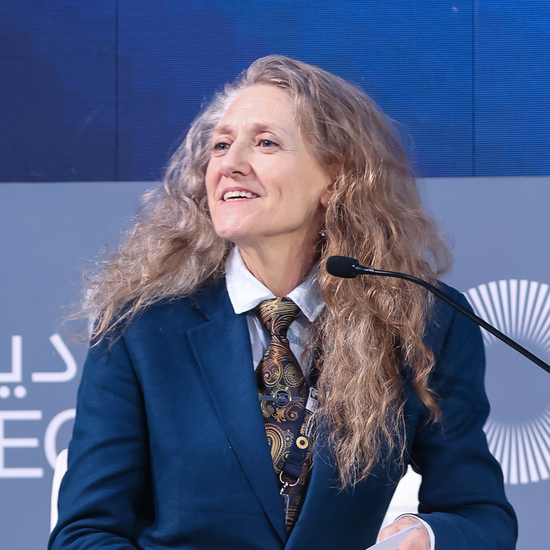
Meg Lin, PhD
Chief Executive Officer
Global Sustainable Fuel Alliance

Why did you create the Global Sustainable Fuel Alliance?
I've spent the better part of 14 years in this industry, working across policy, technology, industry and academia. What became clear is that the sector doesn't lack technology or ambition, it lacks connective tissue. You have strong electrolyser and fuel cell capability in places like Japan and Taiwan, abundant renewable resources in Australia and Chile, and a regulatory architecture being written largely in Brussels such as RED III and RFNBO — but very little of it is linked together into bankable projects. The gap I heard most often from developers is offtake: teams with real production capability rarely have a working relationship with the buyers — this is where the semiconductor fabs, AI data centres and heavy industry players across East Asia and Europe under real pressure to secure firm, zero-carbon energy weigh in.
That's exactly the gap GSFA is built to close. Through our members and advisors across Taiwan, Japan, Malaysia, Singapore, Australia and the EU, we sit directly inside that East Asian demand pool, so we connect producers in Chile or Australia to a real off-taker conversation. Our mandate is technology deployment, so projects get built; project landing, matchmaking supply, demand, technology and capital into replicable value chains anchored by that off-taker access; and policy and standards harmonisation, so a certificate generated in one jurisdiction is recognised and bankable in another.
When do you expect e-fuels to become competitive?
I'd push back gently on the idea of a single tipping point, because competitiveness is already arriving asymmetrically. We're seeing it in the e-methanol projects in Denmark and the e-fuel facilities in Chile — these aren't pilots anymore; they're commercial-scale signals.
One of our GSFA founding members is bringing a green fuel-to-power project online this year, delivering practical ESG implementation at the factory level for a leading semiconductor manufacturer. This demonstrates that e-fuels are already moving beyond demonstration into real industrial applications. So the ramp-up isn't a five-years-from-now story; it's happening now, just not yet at the scale where it can consistently outperform fossil incumbents on price alone.
However, what the next five years will deliver is the convergence of several forces that will close that remaining gap. On the cost side, tightening carbon taxes and mechanisms like the Carbon Border Adjustment Mechanism (CBAM) will increasingly internalise the carbon costs that fossil fuels have historically externalised. On the demand side, corporate commitments under RE100 and SBTi are becoming harder to meet with intermittent renewables alone. At the same time, the shift toward 24/7 carbon-free energy — where clean electricity is matched hour by hour rather than simply offset annually — will become a genuine competitive advantage for global enterprises and their supply chains, rather than just another ESG checkbox.
Companies supporting East Asia's semiconductor and AI expansion, as well as Europe's heavy industry, are not investing in clean energy simply to comply with regulations. They're doing so to remain competitive for capital, talent and customers, all of whom increasingly expect verifiable, continuously available clean power instead of annual accounting-based matching.
When tightening carbon costs converge with growing demand for firm, hourly-matched clean energy, the economics will increasingly favour e-fuels. That's the inflection point we're approaching, and it's precisely where GSFA is focused — helping accelerate the deployment of commercially viable projects that bridge today's cost gap while delivering real industrial decarbonisation.
What impact could the current Strait of Hormuz crisis have on the development of the sector?
It's a sharp reminder of something we've been saying for a while: energy security and supply chain diversification aren't side issues for green fuels, they're the whole point. A crisis in a chokepoint like Hormuz exposes how concentrated and fragile fossil energy logistics still are, and it strengthens the strategic argument for green fuels as a genuinely distributed, multi-sourced alternative.
That's exactly what we convened in Brussels in June — our closed-door expert meeting brought together hydrogen leaders and government representatives from 15 countries across Europe and Asia specifically to chart Euro-Asian hydrogen cooperation. One of the core outcomes was advancing the Power-to-X-to-Power, or P2X2P, pathway as a practical architecture for regional resilience: surplus renewable power gets converted into a transportable carrier like e-methanol, shipped using existing marine infrastructure, and converted back into dispatchable, zero-carbon energy at the point of demand. This approach offers a scalable, infrastructure-compatible route to long-duration energy storage and grid resilience, without requiring costly overhaul of existing networks.
In concrete terms, that means East Asia's demand — Taiwan, Japan, Korea, where semiconductor and AI buildouts are driving exponential demand for firm clean power — will be met by a diversified basket of Pacific-rim suppliers: Malaysia, Singapore, Australia, Chile, the US, Canada etc, and this is the model we're already building through GSFA's member network. A crisis like Hormuz doesn't create the need for that diversification, it makes the cost of not having it tangible — and I'd expect it to accelerate the urgency with which governments and off-takers move from discussing diversified green fuel corridors to contracting and financing them.